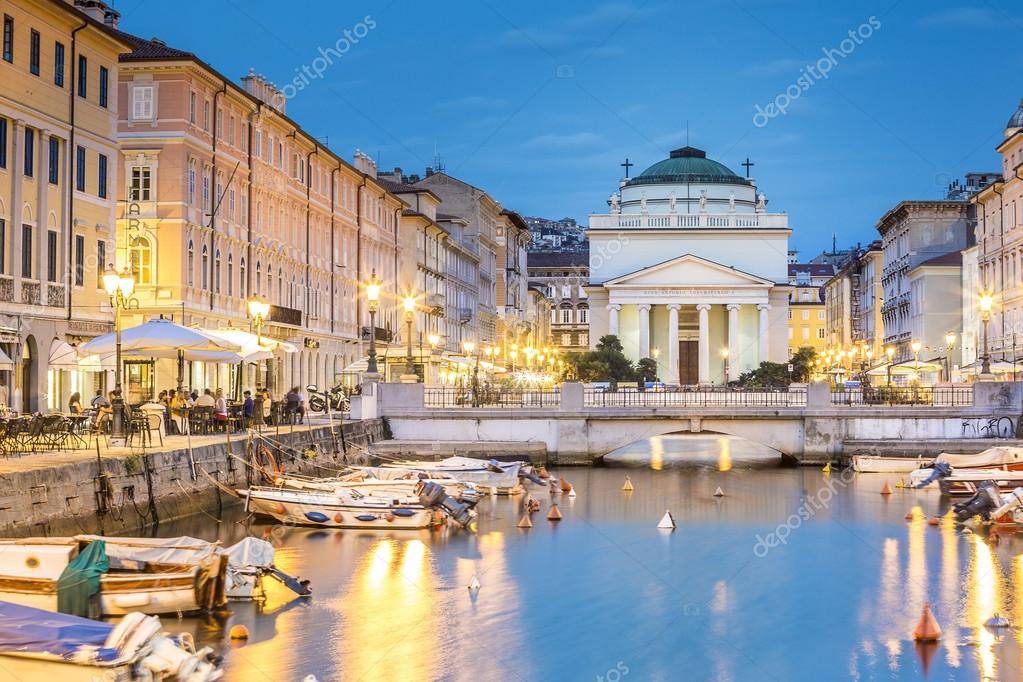
Geographically, Trieste enjoys a unique and beautiful natural location as it is surrounded by the Carsic hills and the Adriatic Sea. The quality of life is high, and one’s leisure time can be spent in tourism, culture and sports without the drawbacks that affect larger Italian cities such as heavy traffic jams, smog, and delinquency. In Trieste, the summers are warm, the winters are long and very cold, and it is partly cloudy year round. Over the course of the year, the temperature typically varies from 38°F to 84°F and is rarely below 30°F or above 90°F. Trieste is not the typical Italian city you may expect. A cultural diversity has been maintained in this city. It has a colorful history that has formed this diversity. From 1382 to 1918, Trieste flourisged as part of Austria, which became the Austro-Hungarian Empire in 1867. In 1918, it was considered one of the most prosperous Mediterranean seaports as well as a capital of literature and music. However, the collapse of the Austro-Hungarian Empire and Trieste’s annexation to Italy after World War I, led to a decline in its economic and cultural importance. As a result, the city lost its strategic and commercial influence. As early as the third millennial BC, the area of what is now Trieste was settled by an Indo-European tribe named the Carni. Afterward, the area was populated by the Histri and Illyrian people, who remained the main civilization until 2000 BC, when the Paleo-Veneti arrived. By 177 BC, the city was being governed by the Roman Republic. It was granted the status of a colony by Julius Caesar, who recorded its name as “Tergeste” in 51 BC. After the end of the Western Roman Empire in 476, Trieste remained a Byzantine military centre. In 788 it became part of the Frank kingdom. From the year 1081 the city came loosely under the Aquileia patriarchy, developing into a free commune at the end of the 12th century.The Castle of San Giusto, built between 1470 and 1630 in the heart of the ancient town on the ruins of the Roman city, is a symbol of that period.Trieste grew into an important port and trade hub in the 17th and 18th century. The city was occupied by French troops three times during the Napoleonic Wars. It was annexed to the Illyrian Provinces by Napoleon. During this period Trieste lost its autonomy and the status of free port was interrupted. After the Napoleonic Wars, Trieste was returned to Austria and the city’s role as the main Austrian commercial port and shipbuilding center was later emphasized by the foundation of the Austrian Lloyd merchant shipping line in 1836, whose headquarters stood at the corner of Piazza Grande. The modern Austro-Hungarian navy used Trieste as a military base and it’s shipbuilding. The particular Friuli dialect, called Tergestino, spoken until the beginning of the 19th century, had been gradually supplanted by Triestine and other languages including Italian, German and Slovenian. While Triestine was the dialect of the majority of the population, German was the language of the Austrian bureaucracy and Slovenian was the language of the surrounding villages. Viennese architecture and coffee houses still dominate the streets of Trieste today. After World War 1 ended and Austria-Hungary disintegrated, Trieste was transferred to Italy (1920) along with the whole Julian March. The annexation, however, determined a loss of importance for the city, both strategically and commercially. The city still preserved it’s cultural diversity from the rest of Italy.
 Welpdidoodlie